
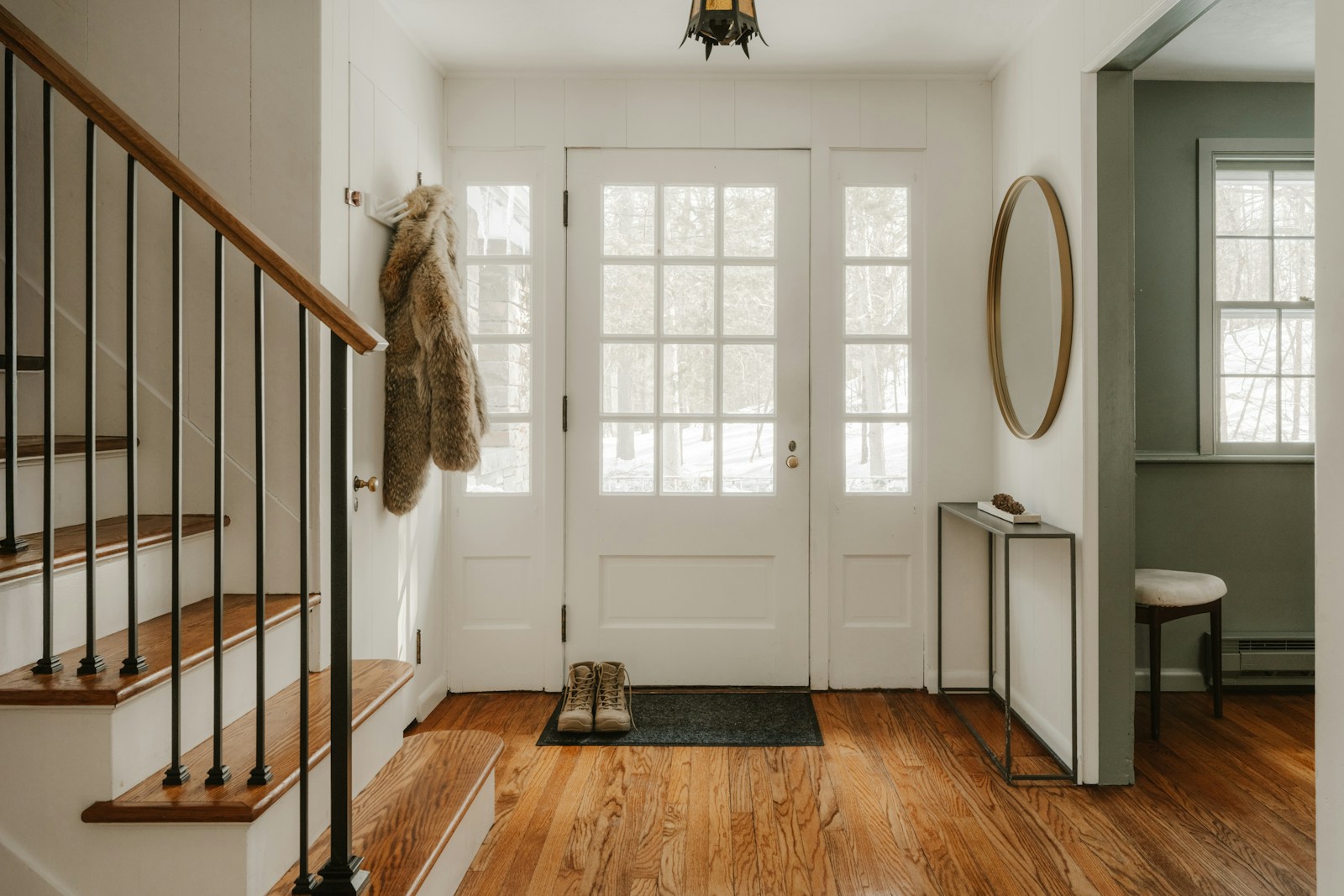

Opening the front door toward a staircase can feel abrupt, but the view alone does not establish a serious feng shui problem. First check whether the door and stairs form a direct line, how close they are, and whether the entry has any transition space.
That check tells you whether the entrance needs a light buffer, a clearer visual stop, or no major change.
Want to check your own entry instead of guessing from one angle? Mark the front door directly in the nine-grid tool.
Not every door-and-stairs setup counts as a strong hit
A quick glance from the doorway is not enough. Check:
- Do the stairs sit on the main sightline the moment the door opens?
- Do the door and stairs line up in an almost straight path?
- Do the stairs go up or down?
- Is there a landing, turn, console, wall, or recessed entry between them?
If the stairs are offset, partly screened, or you reach them only after a few steps of transition, the issue is often much lighter than people assume.
Why this layout feels sensitive in feng shui
The front door is where your home receives movement, attention, and outside energy. Stairs add vertical pull and directional force.
When the two connect too directly, the result often feels like this:
- The entry doesn't settle
- Your eye gets pulled away too fast
- Your body moves before it has a chance to pause
- The home feels like it starts with motion instead of arrival
This is why some entries feel rushed even before anyone starts climbing the stairs. The effect comes from daily movement as well as the symbolic reading.
The three versions that matter most
1. The door opens straight toward a downward staircase
This one gets overstated a lot, but it's also the most commonly uncomfortable version. The visual movement drops immediately, and the entry can feel like it leaks downward.
2. The stairs are directly ahead and very close
Distance matters. A staircase far away at the end of a hall feels completely different from one that starts almost immediately after the threshold.
3. The stairs also control the main circulation path
If almost everyone entering the home must immediately follow the stair line, daily circulation reinforces the hurried feeling.
Create a pause before adding cure objects
Mirrors, symbols, and heavy screens are rarely the best first move. Start by creating a clear arrival area:
- Use a rug to define the threshold
- Add a console or low cabinet to give your eye a resting point
- Improve the light at the entry so the space feels grounded
- Clear the area between the door and the stairs
These practical changes often matter more than decorative cures because they change how the entrance is used.
When stronger screening is actually worth it
If the door and the stairs really do form a sharp line with no transition, then stronger measures can help.
The more stable options are usually:
- A low or medium-height console that interrupts the line gently
- A light screen instead of a heavy full block
- Redirecting attention toward a wall, artwork, or focal surface before the stairs
- Adding visual edge definition if the staircase is very open or transparent
The screen does not need to hide the stairs. It only needs to redirect attention long enough for the entry to register as its own space.
What not to overdo
Many corrections become less useful when they add clutter or block the entry. Avoid:
- Overloading the door with symbolic objects while the entry is still cluttered
- Adding a thick divider that makes the entry darker and tighter
- Treating a mild offset stair like a severe direct hit
- Trying to solve the whole problem with one hanging object
A good correction should make the front door area calmer and easier to use.
How to judge priority
If your layout checks two or more of these boxes, it's worth treating as a real issue:
- The stairs are the first thing you see
- There's little or no transition space between the door and the stair run
- Most daily circulation goes straight through that line
If only one of those is true, the problem may be lighter than issues like a bathroom visible from the entry or a direct line from the front door to a back opening.
What people miss when checking by eye
The staircase is only part of the setting. Also check:
- Does your entry have enough light?
- Is the area under the stairs heavy, dark, or cluttered?
- Does the doorway force an immediate turn?
- Do the railing and stair line create a hard visual arrow?
Those details change the feel of the same basic pattern.
When the tool beats hand guessing
Manual judgment gets unreliable when:
- The front door is off-center
- There's an inner entry or short hall before the stairs
- The staircase turns rather than running straight
- The layout is already irregular in shape
In these cases, place the entry and staircase back into the full floor plan instead of judging from the doorway.
To see whether the entry and staircase create a main rush line, mark the front door and overall layout in the nine-grid tool. The full plan gives you a better basis for choosing a light buffer or a stronger intervention.