

You move the bed away from the bedroom door, only to discover that the wardrobe no longer opens. Turn it the other way and the headboard covers the window. In a small bedroom, a list of feng shui rules can leave you with nowhere to sleep.
If your bed faces the door, first check whether it is actually in the doorway's direct line. Being able to see the door is different from lying directly in front of it. If the bed is aligned, try a modest sideways shift before considering a different wall. Keep the door, windows, and everyday walking routes usable throughout.
This guide uses feng shui as a traditional layout perspective, not as a prediction of illness, bad luck, or relationship problems. The aim is a room that works better, without turning one awkward furniture position into a reason to fear your home.
Does the bed really face the door?
People use this phrase for several different arrangements. Look at the bedroom entrance, rather than the home's front door, and distinguish these cases:
- You can see the door from the pillow, off to one side. This is not the same as the bed being directly opposite it.
- The open doorway leads straight toward the foot or side of the bed. This is the alignment worth examining.
- The door leaf hits the bed when opened. This is a practical access problem, regardless of any feng shui interpretation.
On a simple sketch, extend the width of the doorway straight into the room as a shaded strip. Does it overlap the mattress, graze one corner, or pass beside it? This is a visual check, not a formula for measuring qi or assigning a risk score. A door facing an empty bedside passage should not be treated as identical to a door opening straight onto your pillow.
Also check what happens beyond the drawing. Does corridor light fall across the bed? Can someone passing the open door see the whole sleeping area? Is this the route to an en-suite bathroom? Those observations help you decide which change is worth making.
What the commanding position means here
In feng shui, the commanding position commonly means having the room entrance in view, keeping the bed out of its direct line, and placing the headboard against a solid wall. The International Feng Shui Guild describes these placement principles. They are traditional guidance, not proof that a particular arrangement causes a health outcome.
“Diagonal to the door” describes the relationship between the bed and entrance. It does not mean that you should rotate the mattress diagonally across the room. A bed can sit squarely against a wall while the door is visible off to one side.
Use this arrangement as an option to test, not as a demand to sacrifice access. A bed that blocks a doorway is not a better choice simply because its headboard now occupies a preferred wall.
Compare the usable walls before moving furniture
Sketch the room with the actual bed frame, not just the mattress dimensions. Include the door swing, windows, wardrobe doors, radiators, and fixed furniture. Then compare the walls where the headboard could realistically go.
For each option, ask:
- Can the bedroom door open without striking furniture?
- Can everyone using the bed get in and out in a way that suits their mobility?
- Can the wardrobe, drawers, and windows still be used?
- Is there a clear route to the room exit and any en-suite bathroom?
- What light, noise, or drafts would reach the pillow in this position?
- Is the bed outside the doorway's direct line, or could it shift slightly to the side?
Do not assume that every household needs identical furniture spacing. Test the route with the people who use it, including any mobility aids. A photographed room can look generous while the space between a projecting bed frame and an open drawer is surprisingly tight.
If the bed cannot move to another wall
Start with the least disruptive adjustment. You may be able to improve the room without buying anything.
Shift sideways rather than rotate
Where space allows, moving the bed along the same wall can take the pillow or most of the mattress out of the door's direct line. Check both sides afterward. There is little value in creating a wider passage on one side if the other person can no longer leave the bed comfortably.
A smaller bedside table, or removing a table you rarely use, may make this possible. Measure the bed frame first; its corners are what your legs meet, not the outline of the mattress.
Address privacy without adding an obstacle
If the real annoyance is an open view from the corridor, consider how the bedroom door is used before adding a screen. Avoid placing a bench, chest, or tall divider in the only walking route merely to interrupt an imaginary line.
In a larger room, a stable divider outside the access route might help with privacy. In a compact room, adding furniture can be the worse trade-off. Decorative objects are optional; none should be presented as a guaranteed way to cancel a layout problem.
Keep the bed and reduce the actual disturbance
Sometimes the current wall is the only workable one. If so, investigate the specific nuisance: hallway light, a rattling door, visible storage, or a lamp reflected toward the pillow. Resolve the issue you can observe instead of rearranging the entire bedroom to satisfy a diagram.
For changes that do not require building work, see our rental-home feng shui guide.
What if the alternative is a bed under a window?
Do not automatically swap a door alignment for a window problem. Compare the actual conditions: window height, opening direction, privacy, curtains, nearby heating, and whether the bed would obstruct ventilation or an escape route.
A headboard is not a reason to cover a window that needs to remain accessible. Equally, a window somewhere on the headboard wall does not mean the whole wall is unusable. A bed between two windows is a different arrangement from a tall headboard blocking a low opening.
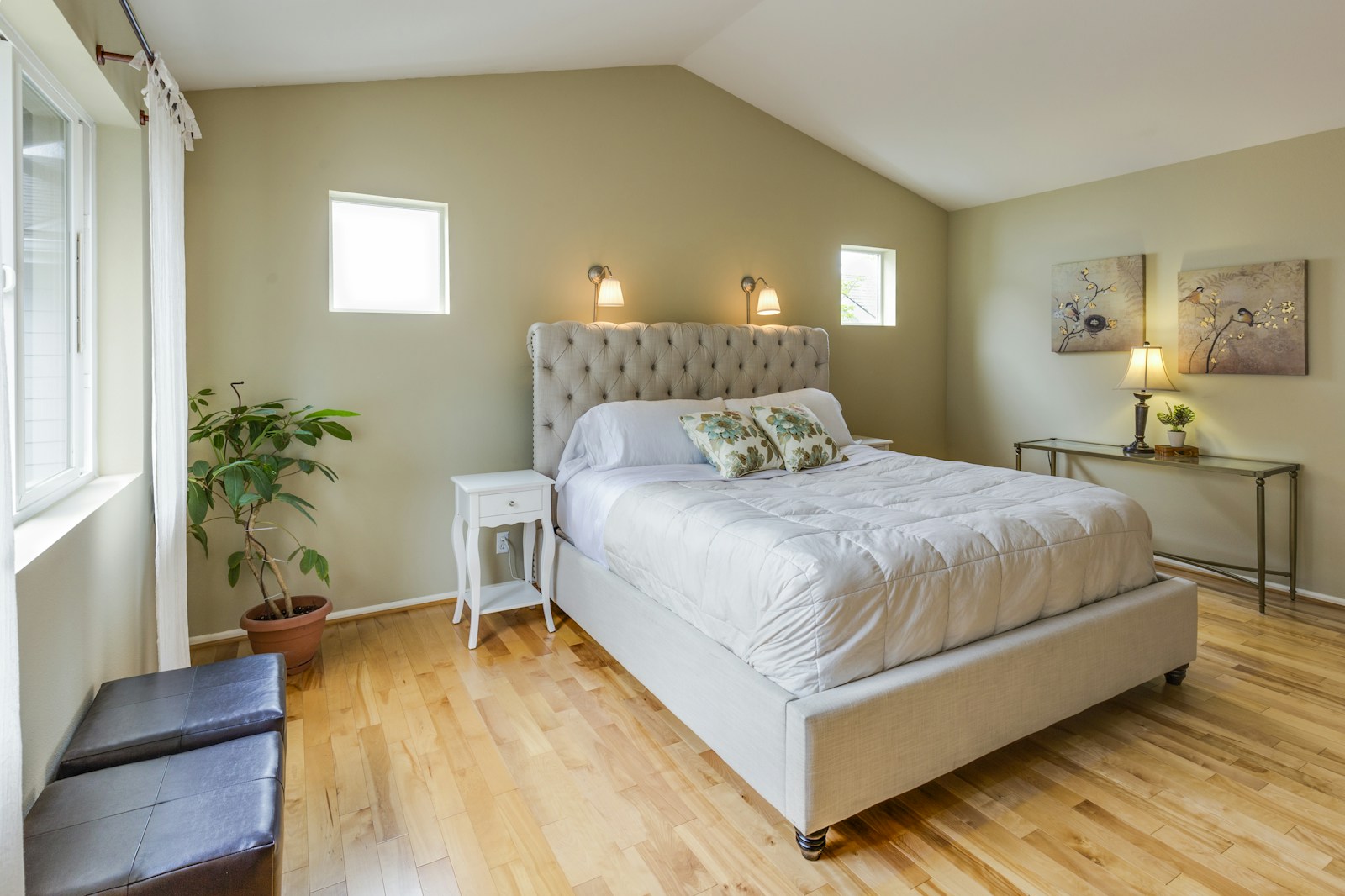
Our cover photograph illustrates this distinction: the bed has wall behind its headboard, with windows nearby. The room entrance is outside the photograph, so the photo alone cannot establish whether the bed is in a commanding position. Attractive bedroom photography is inspiration, not a complete layout assessment.
A small-bedroom example: choose between two imperfect options
Imagine a rectangular room with a door near one corner, a window opposite, and a fixed wardrobe along the right wall. The bed currently faces part of the doorway.
Turning the bed ninety degrees removes that alignment, but now the wardrobe cannot open fully and the route to the window narrows. That option solves one concern by creating two everyday problems.
Instead, draw a second version that keeps the headboard on its existing wall and moves the bed sideways after replacing a bulky bedside table. If the doorway strip now passes mostly beside the bed and both occupants still have usable access, this is the more practical candidate. If it does not fit, keeping the original position may be preferable.
Try the alternatives on paper before moving heavy furniture. This is an illustrative comparison, not a claim that every room has a hidden perfect position.
Bed position is not the same as its nine-grid palace
The relationship between bed and bedroom door is a local room question. A nine-grid review asks where the sleeping area sits within the whole home, after its north direction has been confirmed. Moving a bed away from the door may leave it in the same palace. Conversely, a bed can cross a grid boundary even though the bedroom itself has not changed.
Keep both scales in view. Do not crop away the rest of the home just to make one bedroom look larger for a whole-home assessment. If needed, start with our guide to preparing a floor plan for AI recognition.
You can try AI floor plan recognition to place the sleeping area in the context of the home, then confirm orientation before continuing. The image cannot tell the AI whether your wardrobe door catches the bed frame or whether corridor light bothers you at night. Check those details yourself; use the review alongside them.
Questions people ask before moving the bed
Is a bed facing the door always bad feng shui?
Direct alignment is traditionally avoided, but seeing the doorway is not itself the problem. Examine the actual relationship and the room's constraints. An awkward position is not a prediction about your life.
Must the bed point north?
There is no single compass answer used by every feng shui method. First make the layout usable. If you are reviewing directional considerations, use a reliable reading and distinguish the headboard direction from the bed's location within the home. Our house-facing direction guide explains how to orient the drawing.
Do I need two matching bedside tables?
They can create visual balance, but matching furniture is not worth losing the walking space you need. Choose useful surfaces that fit the room rather than forcing a showroom arrangement into a smaller space.
What should I change first?
Fix an obstructed door or difficult access first. Then test whether a small sideways move improves the bed-to-door relationship. If moving the bed would make daily use worse, keep it and address the disturbance you can actually identify.
Cover photo by Francesca Tosolini on Unsplash.