

The longest wall holds the television. The opposite side is mostly windows, and the route to the balcony runs through the living room. Advice to put the sofa against a solid wall sounds simple until you try it in this apartment.
In feng shui, a supported back and a view of the entrance are common preferences for the main seat. They are useful starting points, but they do not tell you which workable arrangement to choose when your room cannot offer both. Start with the seat you actually use, then check the door, the space behind you, and the route everyone walks.
If the living room connects several parts of your home, you can start with a free AI-assisted floor plan assessment. Confirm the recognized rooms and orientation, then compare furniture positions in the actual room. A floor plan alone cannot tell you whether a seat feels exposed or a window is awkward to open.
What does a supported back mean in feng shui?
Traditional placement advice often favors seating backed by an interior wall. For example, The Art of Wind and Water's living-room guide recommends walls behind the main seating rather than doors or windows.
The related idea of the commanding position concerns your view of the entrance. Anjie Cho explains it as being able to see the door without sitting directly in line with it. Seeing the entrance and aiming the sofa straight at the doorway are different things.
These are feng shui interpretations, not evidence that an unsupported sofa causes financial trouble or family conflict. You can use them as preferences when comparing layouts without treating a window behind the sofa as an emergency.
Nor does backing mean squeezing every piece of furniture against a wall. A wall-backed sofa can still be inconvenient if it forces people to squeeze past the coffee table whenever they cross the room.
Compare the seat, not just the sofa on the plan
Sit where you usually read, talk, or watch television. Can you notice someone entering without turning your whole body? Does a person going to the kitchen pass behind your head or between your knees and the coffee table? Can you get up without asking someone else to move?
Check the other seats too. An L-shaped sofa can give one person a clear view of the entrance while another sits with their back toward it. Calling the entire sofa either good or bad misses that difference.
Here is a useful first comparison:
| Arrangement | What to check | A modest first trial |
|---|---|---|
| Sofa against a solid wall | Whether the main seat can see the entry and the passage stays clear | Adjust the chair or coffee table before moving the sofa |
| Sofa below a window | Window access, privacy, drafts, and heating or ventilation equipment | Test appropriate window coverings and the necessary clearance |
| Sofa with its back toward the entrance | Whether arrivals pass directly behind the main seat | Try a different seat or orientation if the room allows it |
| Sofa floating in an open-plan room | Where the sitting area ends and the walking route begins | Mark the route before considering a narrow console |
The trials are ways to compare daily use, not a formula for a feng shui score.
When the only practical position is under a window
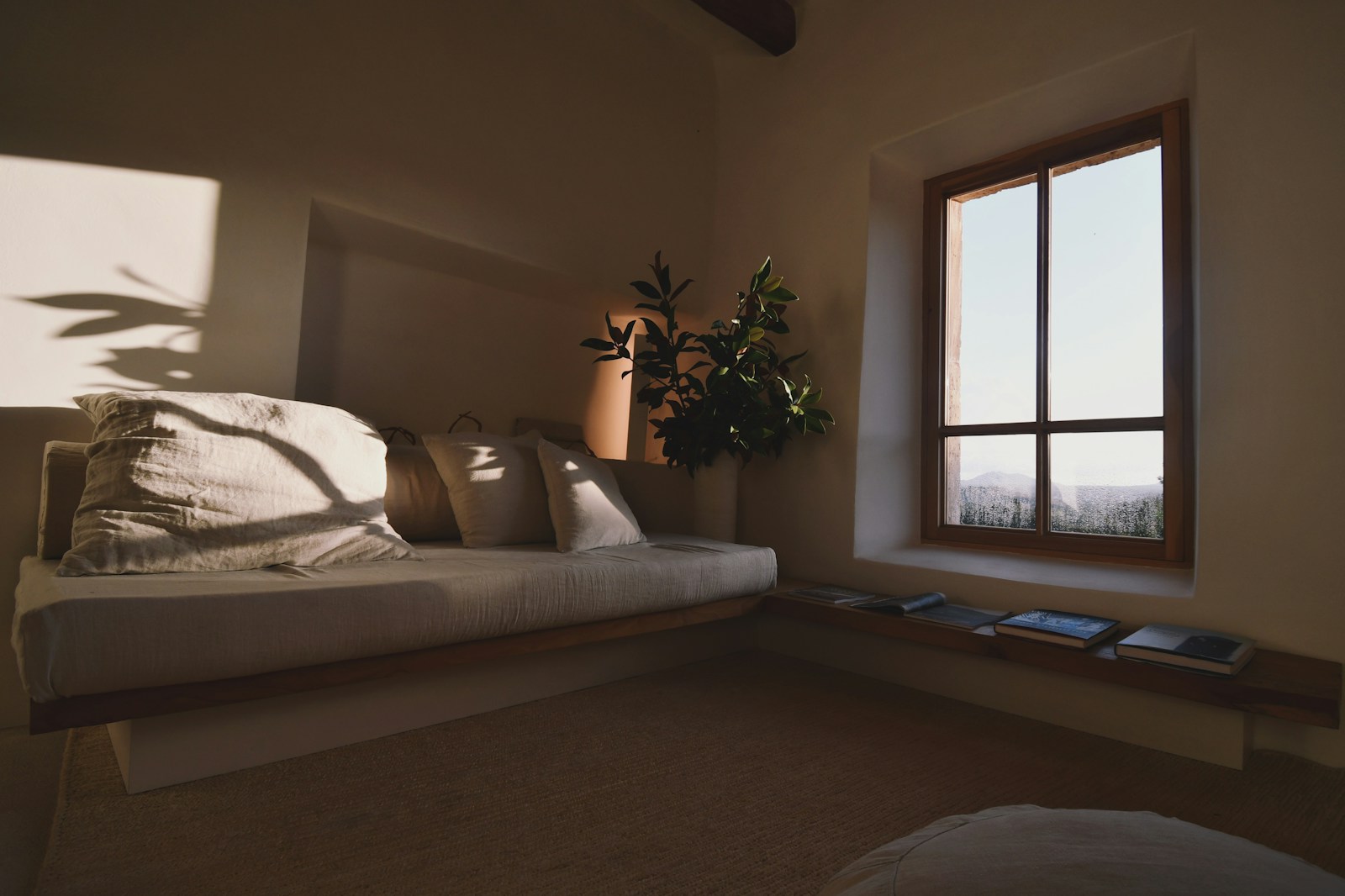
A sofa beside a window is not the same as a sofa directly underneath one. The cover photograph shows a wall-backed seat with a window to its side. It illustrates that distinction; the photograph does not show the entrance or the entire room.
If your sofa does sit below a window, open the window and operate its handle and coverings as you normally would. Check whether the furniture blocks ventilation, a radiator, or a required escape opening. Follow the equipment's clearance instructions and keep access available. A feng shui preference is not a reason to obstruct these functions.
For privacy or distracting light, suitable blinds or curtains may be enough. They change what you see and how the seat feels, but they do not turn glass into a solid wall or guarantee a symbolic result. Do not add a tall cabinet just to pretend the window is gone.
Sometimes the alternative is worse: moving the sofa to a wall would block the balcony door or leave the television visible only from an uncomfortable angle. In that case, work with the window-backed arrangement and address the specific inconvenience you can identify.
Can a sofa float in an open-plan living room?
In an open-plan room, the sofa may separate the sitting area from the dining table. Pushing it to the nearest wall can erase that division and make the room harder to use.
Imagine a small apartment with a kitchen on one side and balcony doors at the far end. The sofa sits between the dining and sitting areas, with a clear route along one side. Rotating it to obtain a wall behind it would put the chaise across that route. This is an illustrative layout, not a client case. Keeping the route open is a reasonable reason to leave the sofa where it is.
A narrow console behind a floating sofa can define the back of the seating area if there is genuinely space for it. It is a piece of furniture, not a substitute wall in every feng shui approach. Check its stability and any anchoring instructions, and avoid a surface that crowds the passage or puts loose objects immediately behind someone's head.
You do not have to add anything. Before buying a console, mark its footprint with a floor-safe temporary method and walk past with a laundry basket. If the passage becomes awkward, the proposed fix has created a new problem.
What if your back faces the door?
First establish which door matters in daily use. The entrance people actually use is more relevant to this check than a cupboard door visible on the drawing. In a living-dining room, include the main opening through which people approach the seats.
Try sitting at the other end of the sofa or using a nearby chair. If that gives you a better view without moving furniture, it may be all you need for your preferred seat. If the whole arrangement needs changing, compare two positions on a measured sketch before lifting a heavy sofa.
A large mirror is not an automatic solution. It may show the entrance, but it can also reflect a bright window or television. Check the actual reflection and installation requirements rather than buying one on the assumption that every back-to-door seat needs it.
Test one change before committing to the room
Keep the television, lights, and other furniture mostly as they are while trying one layout adjustment. Use the room in the evening as well as during the day. Ask the people who share it whether getting to the balcony, kitchen, and seats is easier or harder.
There is no universal compass direction that makes every sofa right. The living room's position within the home and your view from a particular seat are separate questions. If you are comparing whole-home arrangements, review the overall layout with the free assessment. Keep checking furniture dimensions yourself; the report does not certify clearances or automatically choose a sofa position.
If the new arrangement gives you a comfortable view and leaves the route clear, keep it. If it only satisfies a rule on paper while making the room annoying to use, put the furniture back.
Related reading
- Small apartment feng shui: entry, sleep, and storage
- Rental home feng shui without renovation
- Home office desk placement and the view of the door
Cover photo by Max Harlynking on Unsplash.